
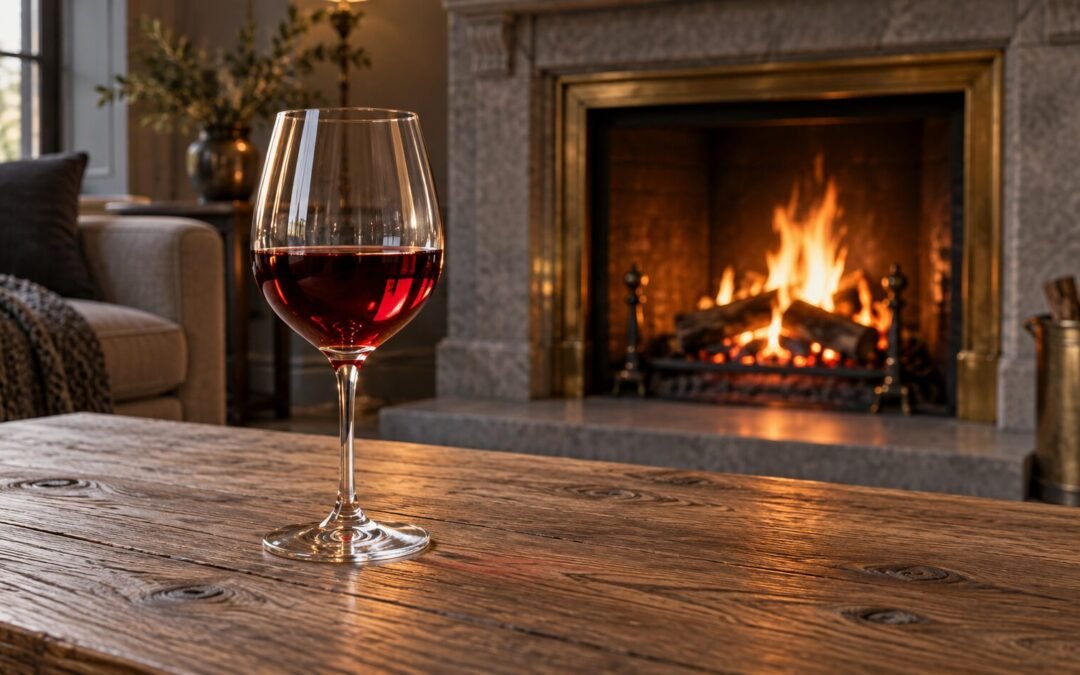
Most evenings I don't drink. Some evenings I do — a birthday, a dinner with friends, a long table where sharing an organic bottle from one of the local wineries with people I love is part of the pleasure. Recently I compared two nights on my WHOOP — one after an evening with wine, one after an evening without — and put them side by side.
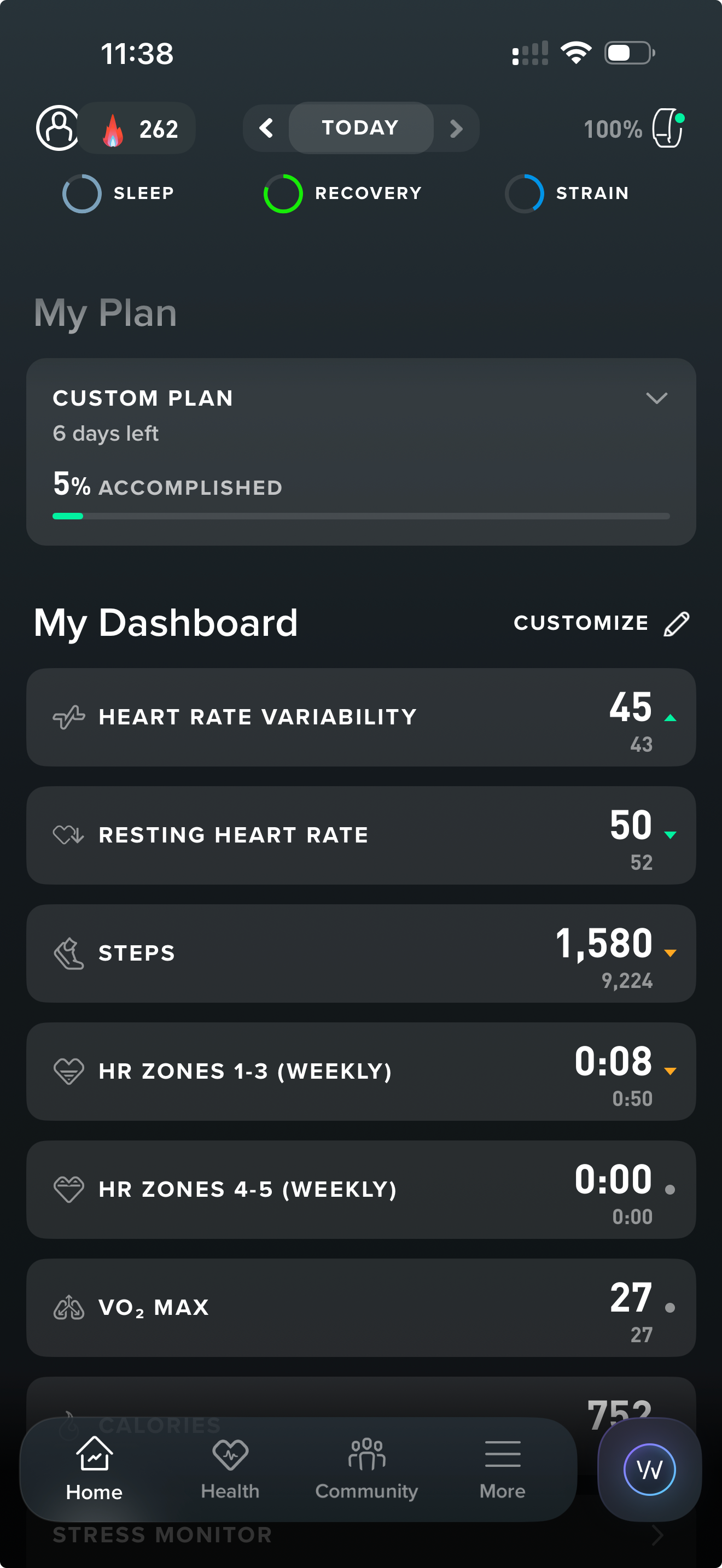
Without alcohol: HRV 45, resting heart rate 50.
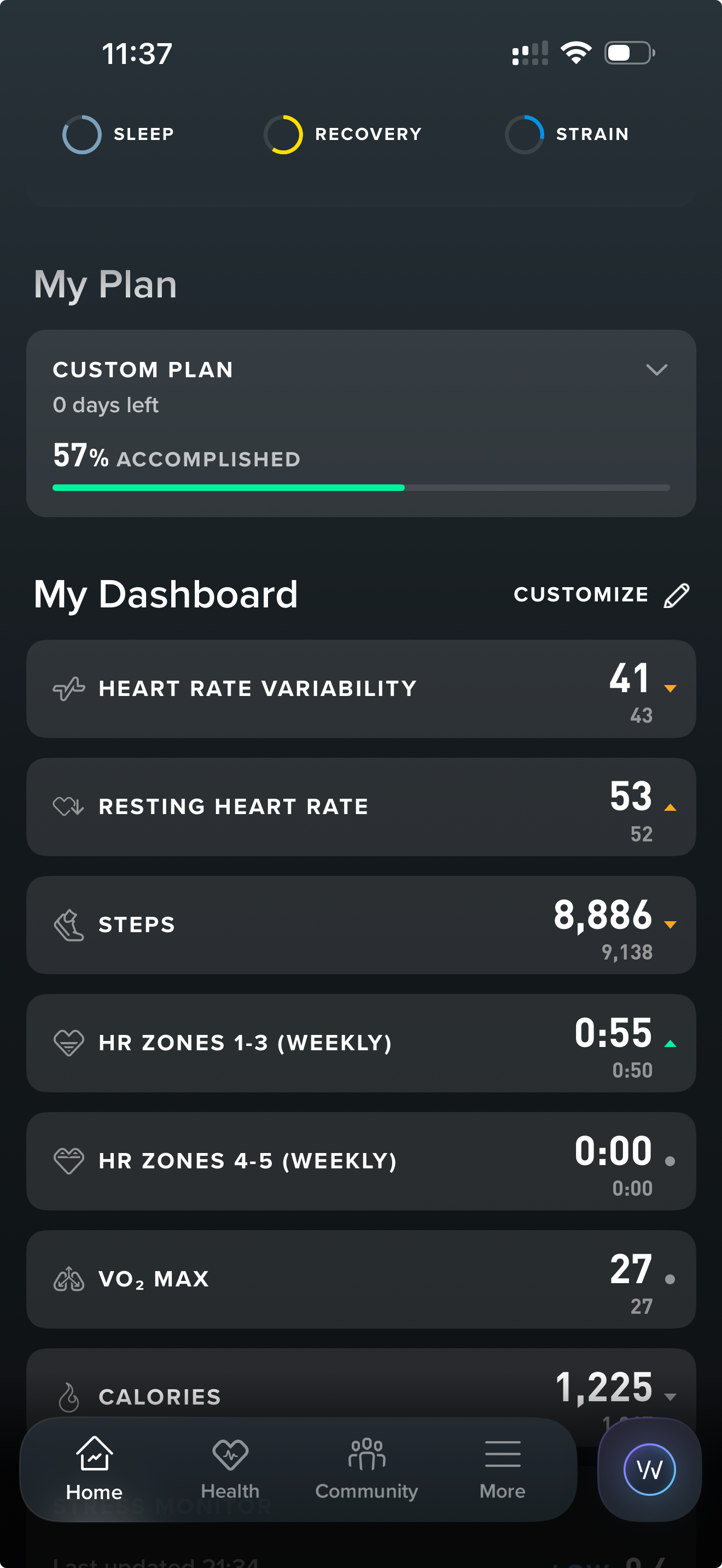
With alcohol: HRV 41, resting heart rate 53.
One evening. Nearly a tenth of my HRV gone, and my heart beating three times a minute faster while I slept. I usually wake up a little tired after an evening with wine. This time I could see why, and the numbers are worth understanding, because the morning tiredness is only the part you notice. Most of what happened overnight goes unfelt.
What alcohol and HRV have to do with each other
Heart rate variability is the small variation in timing between one heartbeat and the next. When you're deeply asleep and your body has come off duty, that variation widens — the heart is relaxed enough to be flexible, and the part of the nervous system responsible for repair is in charge. When the body is still working, the variation narrows.
So overnight HRV is one of the clearest readings you have of whether your body rested or simply lay still.
Alcohol keeps the body working. It has to be processed, and that takes hours — most of them after you've gone to bed. The heart works alongside it. The result is a night where you're unconscious but your body is still busy.
What struck me was that the two numbers moved in opposite directions. HRV dropped from 45 to 41. Resting heart rate rose from 50 to 53. Against my usual averages of 43 and 52, the night without wine sat on the better side of both, and the night with it on the worse side of both. Neither shift looks dramatic on its own. Together they describe a body that never fully came off duty.
What the research shows
My two nights are one woman's data. The research says the same thing at scale.
In 2018, a Finnish study published in JMIR Mental Health analysed heart-rate recordings from around 4,100 employees going about their ordinary lives. In the first hours of sleep after drinking, heart rate was higher and HRV was lower, and the effect grew with the amount drunk. It showed up at low intake too.
A 2021 laboratory study from SRI International, published in SLEEP, asked the same question under controlled conditions, giving men and women measured doses of alcohol in the evening. Same direction: heart rate raised and HRV reduced through the night, with larger changes at higher doses.
It's also well documented that alcohol helps you fall asleep and then disturbs the second half of the night, as the body finishes processing it and sleep becomes lighter and more broken. For many women, that's the 3am waking — the one they put down to stress or age.
Why the glass feels like switching off
This is the part the data can't show.
For a woman who has been holding everything since six in the morning, the first glass of wine is often the only moment in the day that clearly ends it. The shoulders drop. The mind slows. It works within about twenty minutes, and it's one of the most socially approved ways to stop.
What it works on is the feeling. The sedation is real; the recovery isn't. Her body spends the night processing rather than repairing, and she wakes with a little less to draw on than she thinks.
Wine gives you the feeling of the day ending. It doesn't give your body the night that feeling is supposed to lead to.
If the glass has become the only reliable off-switch, that tells you something useful. Your body hasn't got another way down — and that is what's worth working on.
The 80/20 I actually live by
I haven't given up alcohol, and I'm not suggesting you do. Roughly eight evenings in ten, I don't drink. The other two, I join in, because a long table with friends is one of the good things in life.
The single night isn't the issue. One night at HRV 41 recovers. Every night at 41 becomes your baseline, and you stop knowing what 45 feels like.
On being the odd one out: it matters much less than you'd think. Most people are too absorbed in their own evening to notice what's in your glass.
And lately my aperitivo is kombucha in a proper wine glass. Same hour, same glass, same pause at the end of the day. My body seems to take the signal almost as well — which tells me the ritual was doing more of the work than the wine ever was. Keep the ritual. Change what's in the glass, most of the time.
Where to start
If the evening glass has quietly become the thing that switches you off, your body has most likely been on duty for a long time.
If this resonates, the Inner Stability Quiz is a good place to start — it takes five minutes and tells you what your system is actually doing.
Sources: Pietilä J. et al. (2018) Acute effect of alcohol intake on cardiovascular autonomic regulation during the first hours of sleep in a large real-world sample of Finnish employees. JMIR Mental Health 5(1):e23. · Impact of evening alcohol consumption on nocturnal autonomic and cardiovascular function in adult men and women: a dose–response laboratory investigation. SLEEP 44(1), 2021 (SRI International).